Artist Highlight: François Boucher
(September 29, 1703 – May 30, 1770)
Francois Boucher was a proponent of the Rococo style and is the painter most associated with 18th century France. Born in Paris, Boucher was considered a man of the Enlightenment, but at the same time, a man who unashamedly took delight in life’s pleasures, which is a concept that remarkably illustrated in his art.
Gaining Skills and Talent
History portrays Boucher as a straightforward, kind and generous man in all his dealings. It was said that he freely gave of his work to anyone who desired them. As with many painters, there is little recorded information to give us an indication of Boucher’s early artistic studies, for it was unusual at the time to record an artist’s work before he became famous. Boucher worked as an apprentice to Francois Lemoyne (1688 – 1737) and to the engraver Jean Francois Cars. Lemoyne considered a master, worked for Louis XIV and is responsible for the painting of the Hercules Salon at Versailles. His Apotheosis of Hercules was completed in 1736. It was only one year later in 1737 , that Lemoyne suffered a nervous breakdown due to excessive work and the pressure placed on him by the demands of the Court. At the same time, he was burdened by grief from the lost of his wife. Consequently, he suffered a tragic death after stabbing himself nine times in the chest. It is apparent that his skills as a painter were impacted greatly on the future work of Boucher. The Woman Bathing, (1724) reveals considerable likeliness to Boucher’s feminine nudes. (See illustration) Whereas Narcissus, painted by Lemoyne in 1728, exhibits a color pallet already reminiscent of the Rococo period. (See illustration )

Boucher was also inspired by the older painter Jean – Antoine Watteau (1684 – 1721), who like he, had also come from impecunious beginnings but achieved great success from hard work and perseverance. The influences of Watteau can be seen in Boucher’s treatment of background detail. In 1723, Boucher won the the Grand Prix de Rome, a prestigious competition for gifted artists, which provided the winner the opportunity to study in Italy. However, he postponed his travel to Rome until 1727. At the age of seventeen, he submitted The Judgment of Susannah, his interpretation of a well known Biblical story on adultery taken from the Old Testament. (See illustration )

This painting, executed in 1721, vividly portrays the energy and drama of a woman falsely accused and about to be persecuted before being rescued by Daniel. Boucher portrays a remarkable use of High Renaissance technique with regard to form, composition and perspective. A heavy Italian influence is prominent with the use of classical ruins and motifs. The painting depicts a delightful use of color that is also reminiscent of the Italian school, but what is most fascinating about the painting is the skillful sense of drama and emotion that speaks more to the 17th century Baroque than the 18th century Rococo.
Societal Influence
In stark contrast to Versailles in the 18th century, Paris for the young aristocrats was an exciting place to dwell. Everything in society, from adultery to gambling, was reflected in a stylish manner. It was a sensual city where both the pleasurable and enlightened abounded, while always mindful of the thin line between wit and vulgarity. Paris led the world in culture, language and fashion; all of this was reflected in Boucher’s works. Boucher’s art illustrates the cultural preoccupation of the 18th century. Paintings of the period, and especially in the context of Boucher’s work, were required to compliment the architectural interiors for which they were commissioned. Many were used to fill the panels of walls or spaces above mirrors and doors. Interiors of the 18th century were much smaller and more intimate than those of the century before. Pastel colors of rose, green and blue were the dominant shades of this period as opposed to the rich tones of the 17th century.
The trend was not of public display but of personal with regard to acquired art where owners could personally take delight in and enjoy the beautiful creations. Many patrons selected paintings for intimate spaces such as a collector’s cabinet room or gallery. Here paintings were hung frame to frame to fill the space of the wall, regardless of the subject matter. Pictures were selected for their interest and beauty, their pleasurable qualities instead of their intellectual qualities. This aspect was the basis of what later would become known as the “private art collection” which since have become used to form some of our first art museums. Painters of the period were mindful of the expectations of society and delivered accordingly. Patrons used their purchasing power to encourage personal preferences, which fostered a sense of competition between artists.
In 1729, Boucher again surprised Parisan society with his unusually explicit, seductive and sexual rendition of the story of Hercules and Omphale. Here he illustrates a scene of tender lovemaking in the intimate bedroom of Queen Omphale. Hercules, overcome with love, is distracted from his heroic exploits and will suffer the consequences. (See Illustration)

Here, the red and gold colors are more reminiscent of a Venetian painter than of an 18th century French painter, which further exemplifies how diversified Boucher’s talents were.
A Developed Style
On his return from Italy in 1731 at the age of twenty eight, Boucher found that the Rococo style was in full swing. He really aspired to be a history painter, but patrons of the day preferred to buy that kind of painting only if they were created by Renaissance masters. A frustrated Boucher decided to take matters into his own hands by creating several paintings without commission, hoping to attract significant attention to his work. At this point in his career we begin to see the essence of the “Boucher” style emerge. Boucher paintings are remarkably gorgeous depictions of life captured in fantasy. Inspired by both classical art , especially Venetian artist such as Tiepolo, and 18th century cultural pursuits, Boucher’s paintings capture life in an idyllic and tranquil setting. Luscious female nudes languish about alongside voluptuous putti. As a painter of the female nude Boucher had no equal in his generation.


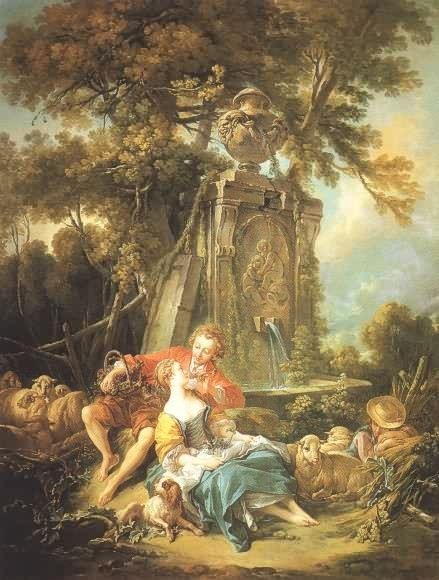
His pastoral landscapes illustrate a life of devotion and attentiveness between lovers. Often he drew from common folk, such as the shepherd and shepherdess for inspiration, doing the ordinary things of life. Like Watteau, Boucher was a master at detail and filled his backgrounds with an abundance of flowers, trees, animals and other items taken from nature. His paintings often portray a central triangular composition of figures which are emphasized by a masterful use of light as a technique to cast a theatrical aspect to the illustration. His color pallet is rich with colors of blue, red, green, and yellow and gold but appear muted with touches of white. This technique adds delicate and calming effect to his art and permitted his creations to fit beautifully with the Rococo style. He to abandoned symmetry in favor of asymmetry.


The Rape of Europa was painted in 1733. Like many of Boucher’s paintings, this painting could be categorized as amorous since the bull in the center of the painting could hardly be construed as threatening or harmful. In fact, Boucher has brilliantly illustrated the character of the bull, for according to the mythological tale, Zeus, smitten by Europa, conceived a plan to deceive Europa into falling in love with him by transforming himself into a lovely white bull and then camouflaging himself with the herd of cows that belonged to Europa’s father. As Europa picked flowers amongst the herd in the pasture, she saw the beautiful bull and instantly became enamored of his gentle face. As she caressed his flanks, she gently climbed on his back. Zeus then carried her away to the sea. Through the tides, he swam carrying a fearful Europa with him, until reaching his destination of the island of Crete. There he revealed his true identity and made her his queen. (See illustration)
Although his early works, to some degree, appear innocent and idyllic, with time Boucher ventured into the erotic, a transition which was perhaps a reflection of the era.
The Toilet of Venus, 1751, and the nude painting of Marie- Louise O’Murphy, 1752, are both examples of such work. The Toilet of Venus was commissioned to be added to the décor of Madame de Pompadour for her “cabinet de toilette” (small room used for intimate matters) at Chateau de Bellevue. The allegorical painting depicts several symbols of love that include cupids and doves which are attributes of Venus, the goddess of love. The pearls represent her mysterious birth from the sea, while the flowers allude to her role as patron saint of the garden and Madame de Pompadour’s love of flowers. With these creations came moral criticism from French philosopher Diderot[1], as a result of which Boucher’s reputation suffered.
Boucher remained constantly supported by his loyal and devoted friend, Madame de Pompadour and in appreciation for her friendship he provided her with lessons in painting. After he was admitted to the Royal Academy of Painting and Sculpture, for which he eventually became director, he won the attention of prominent French society. He secured portrait commissions for other royal patrons and was always known as the favorite painter of Madame de Pompadour. Here Madame de Pompadour is depicted as a refined and graceful woman of the enlightenment as implied with the book she holds openly in her hands. The delicate pastel colors are easily suitable to the interior decor of the 18th century homes.

Boucher was a prolific and accomplished artist who painted more than 1000 paintings and never seemed to bore of his work. His wife, Marie Jeanne Buzeau, modeled for him frequently. He painted in various genres that included the classical, allegorical, religious and the idyllic pastoral. Although painting gave him great joy, painting alone did not permit him to earn enough money to live comfortably, and therefore he was forced to seek work in other artistic areas. Besides painting on canvas, he also painted book illustrations, print work and porcelain. His work can be seen on the finest Sévres decorative objects of art. Boucher also created designs for tapestries. Some exquisite examples of such tapestries are on display at Osterly House in London. In 1755 he became the director of the Gobelins Tapestry factory. Opera was a favorite entertainment of French royal society and Boucher found great pleasure in the design of theater sets and costumes. As the century progressed, Boucher’s professional reputation suffered and his art came to be judged as immoral which undermined the significance of his work. Today he is regarded as one of the great masters of art, worthy of the same praise and recognition often bestowed upon the great High Renaissance
